In the public record, Sergey Kunitsa is three people.
He is the CEO of Paysol LLC, a Russian company that functions as the domestic payment agent for Exved, one of the cryptocurrency platforms in the Garantex successor ecosystem — the same ecosystem that has been the target of five rounds of U.S. sanctions.
He is the sole owner of SK Construction, a general building contractor licensed by the State of California (License #921058), which completed $2.4 million in wildfire rebuild projects in 2025, including a $2 million Pacific Palisades reconstruction.
And he is a property owner in Lehigh Acres, Florida, where Lee County records show a parcel held jointly with Elvira Kunitsa.
Three identities. Three countries. The identification rests on a name match across jurisdictions: Russian corporate records (Rusprofile.ru) list Sergey Pavlovich Kunitsa as the sole owner and General Director of Paysol LLC (ООО «Платежное Решение», INN 9703158615), registered at Federation Tower — Presnenskaya Naberezhnaya 12. U.S. records (CSLB, OfficialUSA) list a Sergey Kunitsa, born September 30, 1960, as the sole owner of SK Construction at 19452 Martin Lane, Santa Ana, California. The shared full name — a surname carried by fewer than one in 89,000 Russians — links the two profiles. CrimsonVector has not obtained a cross-jurisdictional document (such as a matching date of birth on the Russian side) that independently confirms they are the same person.
The Green Corridor
Before cryptocurrency, Kunitsa moved goods.
RMA Logistics was a Moscow-based customs brokerage with offices in Moscow, Guangzhou, and Hong Kong. Its service offering was the physical movement of cargo across international borders — specifically, across Russian customs, where the regulatory environment rewards the right relationships and punishes the wrong ones.
RMA held Russia's "Green Corridor" trusted-trader status, a coveted designation administered by the Federal Customs Service that allowed approved companies to move goods through customs without physical inspection. Green Corridor participants' shipments bypassed the x-ray machines, the document reviews, and the warehouse holds that slow normal importers. The designation was intended for compliant, high-volume traders. It was also, by its nature, a mechanism of reduced oversight — the government agreeing not to look.
RMA Logistics operated a website at rma-logistics.ru that advertised its ability to move cargo across borders with minimal friction. RMA Logistics Inc. was separately registered in the United States (USDOT 3316938), listing a residential address in Westbury, New York — Nassau County, Long Island. Its motor carrier authority was revoked in April 2025.
RMA Logistics is now in liquidation.
The career pipeline is legible. Russia's Green Corridor program was designed to reward compliant importers with reduced oversight. In practice, it created a class of operators who understood exactly how the oversight system worked — and where it didn't. A customs broker who knows which shipments get inspected and which don't possesses the same operational knowledge needed to know which financial transactions get scrutinized and which don't. The skill is not smuggling. It is navigation — the ability to identify the seams in a regulatory system and move cargo through them.
When RMA Logistics entered liquidation, Kunitsa's next venture was Paysol LLC — "Payment Solution" — a company that navigates a different kind of regulatory boundary. Where RMA moved physical goods through customs, Paysol moves value through the banking system. Both operations require intimate knowledge of where oversight applies and where it doesn't.
Paysol and Exved
Paysol LLC (Russian: OOO "Platezhnoe Reshenie" — literally "Payment Solution") is the company that connects the Garantex successor ecosystem to the Russian banking system. Paysol serves as the domestic "agent" for Exved, a platform founded by Sergey Mendeleev — the Garantex co-founder sanctioned by OFAC in August 2025. When a Russian customer wants to convert rubles to cryptocurrency through Exved, Paysol handles the ruble side, interfacing with Russian banks while the cryptocurrency conversion happens offshore, out of sight.
Transparency International Russia documented how this works. In October 2024, investigators posing as a Hong Kong-based electronics exporter contacted Exved via its public Telegram account. Within twenty-five minutes of submitting a company card — no passport scan, no proof of beneficial ownership, no video verification — they were approved and introduced to Paysol as their payment agent.
The Mechanism
The system Paysol described on recorded calls is what Exved internally calls the "agent scheme" (агентская схема). It works in two disconnected circuits:
Circuit 1 (Russia, rubles): A Russian importer pays rubles to a Russian bank account held by a foreign-registered intermediary. The intermediary introduced to TI Russia was Feilian Company Limited, a Hong Kong entity formally owned by a Chinese national (Wei Bing) but controlled under power of attorney by a Russian, Sergey Antipov. The ruble payment is routed through Feilian's account at the St. Petersburg branch of Alfa-Bank. The contract between the importer and Feilian is structured as a domestic agency agreement — a legal payment for services. It makes no reference to cryptocurrency.
Circuit 2 (offshore, crypto): Feilian converts the rubles to USDT and pays the foreign supplier from offshore accounts in Hong Kong, Dubai, or Thailand. The foreign bank sees a clean wire from a Hong Kong company to an exporter. The Russian bank sees a domestic payment to a foreign agent. No bank on either side sees a wallet address.
The separation is deliberate. In recordings published by TI Russia, Paysol's agents were explicit about its purpose:
"The client submits a payment order under the agency agreement without indicating that the payment will be made in crypto — it is presented simply as a currency transfer. The contract makes no mention of crypto. No bank will know. It is visible only between us."
— Chat with Paysol, October 13, 2024
"Everything is legally clean. We've worked this way for years. The client never deals with crypto. We do. And no bank ever sees a wallet address."
— Chat with Paysol, October 2024
The Banks
According to Paysol agents recorded by TI Russia, the service named specific institutions. On the Russian side, T-Bank and Expobank accept the ruble-side payments, processing settlements that reference USDT without objection:
"We've selected banks that don't ask unnecessary questions. They're indifferent. And even if someone inquires, the questions come to us — not you."
— Call with Paysol, October 16, 2024
On the offshore side, Paysol cited J.P. Morgan Hong Kong, Deutsche Bank Hong Kong, DBS Hong Kong, and Bank of China as conduits for the foreign-currency leg, describing them as "working banks" (рабочие банки) — institutions used frequently and successfully, "albeit not without occasional compliance issues." When a foreign bank rejected a transaction, Paysol said, the payment was simply rerouted: "We simply choose another agent or switch the bank. It's a working setup."
Dual-Use Goods
When TI Russia's investigators asked whether Paysol's services could facilitate trade in dual-use goods — microprocessors, telecommunications equipment, the kinds of items subject to export controls — the response was not a denial. It was a sales pitch:
"We have plenty of clients, Russian importers, who bring in dual-use goods from China, Hong Kong, and Taiwan. Telecommunications, microprocessors... We're talking about multimillion-dollar annual volumes, and so on."
— Call with Paysol, October 22, 2024
Tatiana, a compliance officer working with Paysol's legal team, acknowledged that the scheme is commonly used to facilitate import of restricted goods, particularly from China, Hong Kong, and Taiwan. She emphasized "tailored documentation" and the "reassigning of HS codes" — the Harmonized System codes that classify traded goods for customs purposes. Changing an HS code from a controlled category to an uncontrolled one allows dual-use goods to pass through customs screening that would otherwise flag them. Clause 4.8 of the agency agreement prohibits clients from presenting any documents that mention Russian involvement in the transaction.
The Blockchain Trail
The on-chain evidence, analyzed by Sharad Vyas at OCCRP, is specific. Paysol's wallets received $234,366.39 from sanctioned Garantex addresses on December 25, 2024. Paysol wallets transferred $2.66 million through an intermediary that also processed funds from Garantex Europe on January 17, 2025. A separate traced flow shows 60,000 USDT moving from Arvix.pro (an ABCeX alias) to an intermediary wallet, which then forwarded 1,040,090 USDT to a target wallet. These are not aggregate statistics or estimates. They are on-chain transactions, traceable to specific wallet addresses on specific dates.
The relationship between Paysol and the broader sanctions-evasion ecosystem is structural, not incidental. Paysol does not merely process transactions for Exved. It is the mechanism by which Exved connects to the Russian financial system — the bridge between sanctioned crypto infrastructure and unsanctioned Russian banks. Without a payment agent that can maintain banking relationships, Exved cannot convert cryptocurrency to rubles at scale. Paysol is not a peripheral service. It is the bottleneck through which the sanctions-evasion pipeline must pass.
Minimum transaction: $50,000 or ¥350,000. Commission: 3%. Paysol cannot process payments below $20,000. The fee structure is not retail. It is wholesale — designed for the "multimillion-dollar annual volumes" its agents described.
Paysol is not merely in Federation Tower's orbit — it is registered at the building itself. Russian corporate records (OGRN 1237700708123) list Paysol's legal address as Presnenskaya Naberezhnaya 12, premises 17/22 — Federation Tower. The payment agent that bridges the crypto ecosystem to the Russian banking system is domiciled in the same building that houses the exchanges it services. TI Russia separately reported that Kunitsa owns commercial land plots in the Moscow-City complex.
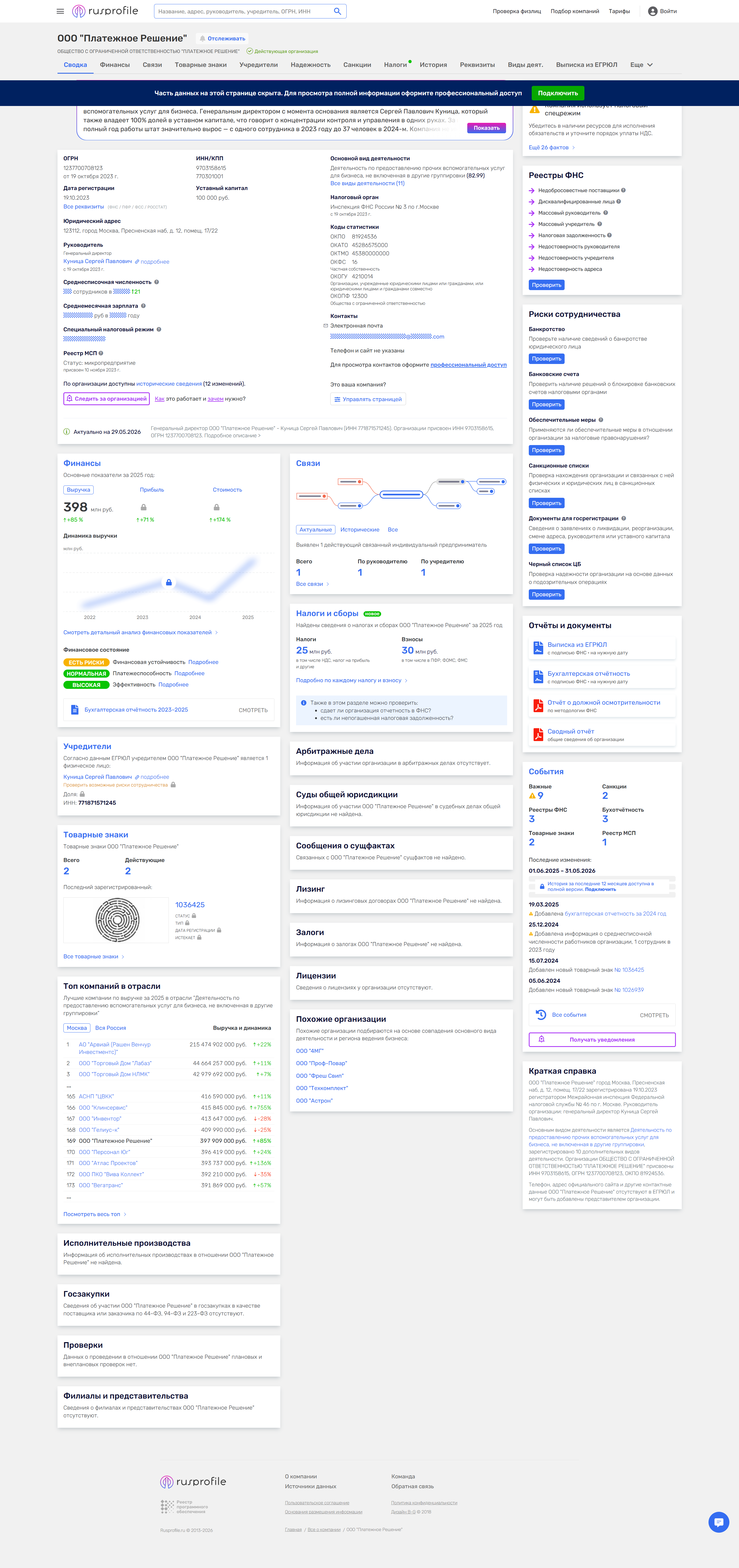
There are also three locked records in the Russian FSGS (Federal Statistics) leak dataset, accessible through OCCRP's Aleph platform, associated with Sergey Kunitsa. The contents of these records are not publicly visible. Their existence suggests additional Russian business interests or income sources that have not been disclosed.
Exved was designated by OFAC on August 14, 2025. Paysol — its payment agent, the entity that actually moves the money — was not.
The American Footprint
Kunitsa's Instagram account (@simonkunitsa) displays a triple-flag bio: Russia, the United States, the Bahamas. The display name is "Simon" — an anglicized alias. CrimsonVector searched Bahamas corporate registries and property databases: zero results link Kunitsa to the Bahamas. The flag remains unexplained.
What follows is documented entirely through public records — state licensing databases, federal motor carrier filings, county property records. No subpoenas were required.
SK Construction holds California State License Board license #921058 under "general building" classification, with Kunitsa as sole owner. The company's BuildZoom rating is 92 out of 100 — 68th percentile among 339,931 California contractors. In 2025, SK Construction completed at least three projects: a $2 million wildfire rebuild in Pacific Palisades, a medical office renovation in La Jolla, and a residential project in San Gabriel. These are not shell operations. They are real construction projects with permits, inspections, and satisfied clients. The California contractor's license is active.
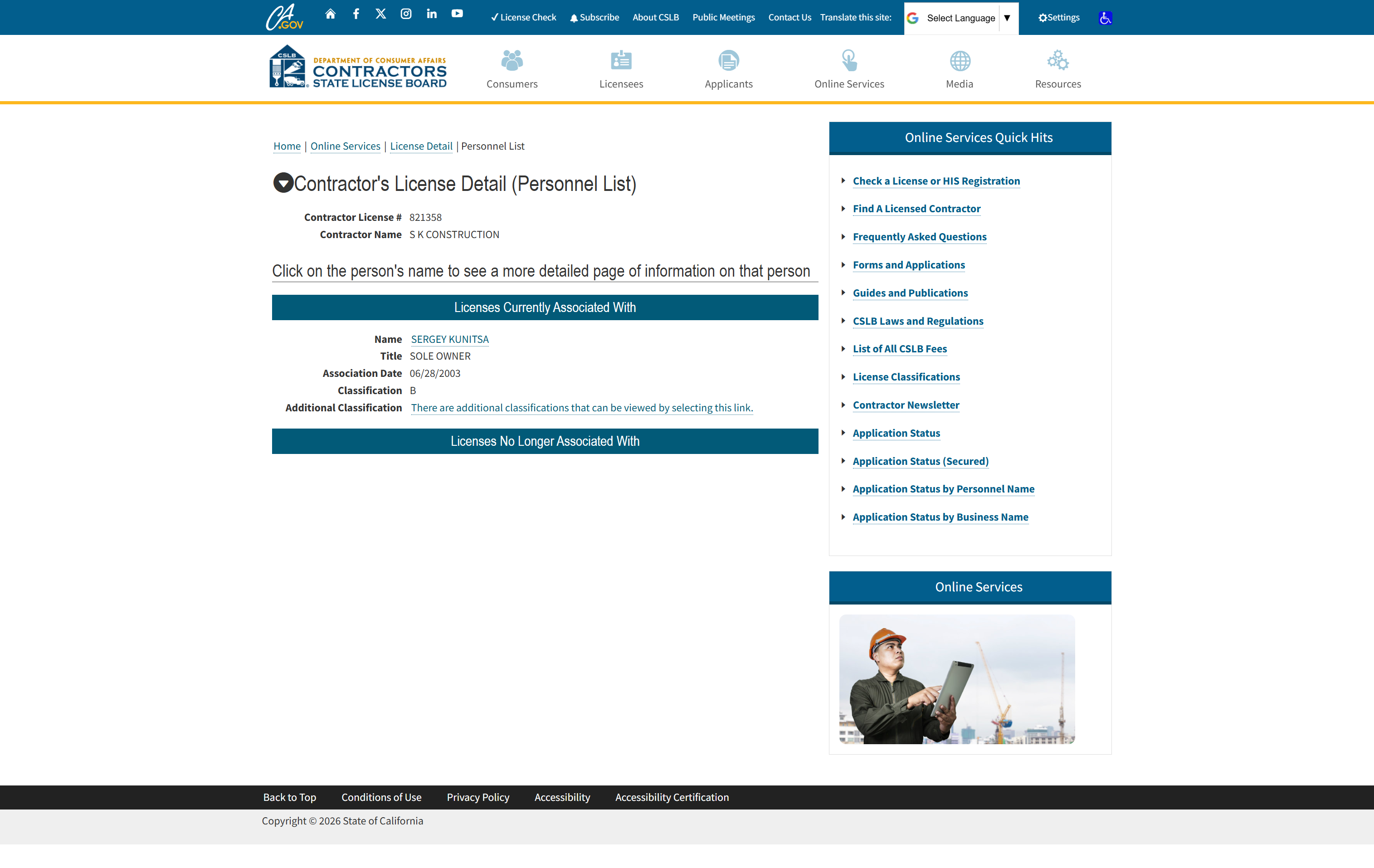
SQ Construction operates from Kent, Washington, under license SQCONC*831M5. The relationship between SK Construction and SQ Construction — whether the same individual or a family member — is unclear from public records.
RMA Logistics Inc. was registered in New York State (USDOT 3316938), listing a residential address in Westbury, New York — Nassau County, with a 516 area code.
The Florida property in Lehigh Acres (Lee County parcel C-06-000-477-0316-0, Lehigh Acres Unit 11) is held jointly with "Elivra" — a likely transliteration of Elvira Kunitsa, who also appears at the Santa Ana address.
The Kunitsa family's U.S. presence extends beyond Sergey's own businesses, spanning construction, trucking, and physical trades across at least seven states. No evidence connects any family members' U.S. businesses to Paysol's operations.
The Enforcement Question
The United States has designated the exchanges: Suex, Chatex, Garantex, Grinex. The United Kingdom, on May 26, 2026, added ABCeX to that list — along with Aifory, Rapira, Arvix, and Mendeleev — in the first-ever application of banking-style sanctions to crypto exchanges. Two governments have now designated the architects: Mendeleev, Besciokov, Mira Serda, Karavatsky. The U.S. has indicted, arrested, and — in Besciokov's case — watched a defendant die in foreign custody.
Neither government has designated the payment agent.
Paysol LLC handles the ruble-side transactions for Exved. Its wallets have directly interacted with sanctioned Garantex addresses. Its CEO holds an active California contractor's license and owns Florida real estate. The jurisdictional exposure is maximal. The United States has every legal tool available:
- OFAC designation under Executive Order 14024 (Russian harmful foreign activities) or E.O. 13694 (cyber-enabled activities)
- DOJ prosecution for sanctions violations (IEEPA), money laundering (18 U.S.C. 1956), or conspiracy
- Asset seizure of the Florida property, California business assets, and any U.S. bank accounts under civil forfeiture authorities
- FMCSA authority to revoke motor carrier operating authority for related trucking entities
- FBAR/FATCA enforcement if Kunitsa is a U.S. person with undisclosed foreign financial accounts (Paysol, Moscow-City commercial property)
None of these tools has been used. SK Construction's license is active. The Florida property is not seized. The motor carrier authority for RMA Logistics was revoked — but for administrative non-compliance in April 2025, not sanctions enforcement.
The question is not whether the U.S. government can reach Sergey Kunitsa. It is why it hasn't. He is not hiding. He is posting geotagged photos from the California coast. He is filing for building permits in Los Angeles County. He is maintaining an active state contractor's license under a transliteration of his own name. His Russian company's wallets have transacted with sanctioned addresses on dates and in amounts that are documented in the public blockchain.
OFAC has shown it can designate deep into the Garantex ecosystem — Mendeleev, Besciokov, Mira Serda, the exchanges themselves, the affiliated platforms. But the designation strategy stops at the exchange layer. It does not reach the payment layer — the companies that interface between the crypto ecosystem and the Russian banking system, the entities that actually convert the rubles. Paysol is that interface. Kunitsa is its operator.
Every sanctions designation of a Federation Tower exchange has been followed by the appearance of a successor. The exchanges are fungible. But the payment infrastructure — the banking relationships, the customs expertise, the physical network of offices and accounts — is harder to rebuild. Designating Paysol would not merely kill a brand. It would remove a piece of operational infrastructure that the successor exchange needs to function.
The gap between the evidence and the enforcement action is the gap that defines this investigation. The exchanges get sanctioned. The person who moves their money walks free in California.
Every factual claim in this article is sourced to specific public records: Transparency International Russia / ICIJ / iStories ("Crypto Laundromat," September 2025), OCCRP blockchain analysis (Sharad Vyas), California State License Board (SK Construction #921058), FMCSA SAFER (RMA Logistics USDOT 3316938), Lee County Florida property records, OfficialUSA, BuildZoom, Instagram (@simonkunitsa), Russian corporate databases (Rusprofile.ru, Checko.ru), and OFAC SDN list.
"The Kunitsa Dossier" is part of "The Address," a CrimsonVector investigation into Federation Tower Moscow.
CrimsonVector is the investigative research practice of Diego Parra.